Music Video Analysis: “1999” by Prince

Prince’s music video for “1999” is lip sync of a live performance, featuring a full band on a grand stage, covered in purple lights. The song itself is about living to the fullest, because one day you’re going to die. This is captured in the prechorus: “Everybody’s got a bomb, we could die any day, oh, but before I let that happen, I’ll dance my life away, oh ho.”

The chorus references the doomsday that comes with the year 2000, where everyone thought the world would end. It’s interesting that Prince chose the setting of a live lip sync performance, instead of a more thematic background for the song. However, by ignoring this, Prince succeeds at utilizing the song’s central message- That we’re all going to die, so might as well make things glamorous while we can. Here’s the chorus- “They say two thousand zero zero party over, oops, out of time, (We’re runnin’ out of time), So tonight I’m gonna party like it’s nineteen ninety-nine (We gonna, we gonna, oh).”

But after watching the music video a few times, I did not find the it to be particularly special, in comparison to other ones I’ve seen- and that’s completely okay. The goal of a music video is to expand music to a visual platform, thus expanding its market reach. In this case, the music video could be seen on TV, or now on Youtube. More importantly, the video is neutral in its themes and stances because it is a live performance. When looking at music videos with a heavy political stance like “This is America” by Childish Gambino, Prince’s “1999” is far tamer. Prince’s song could be interpreted politically, but the presentation of the song in the medium of a music video leaves no room for that. Rather, it relies on the branding of Prince as a musical icon. Therefore, there are no underlying themes to analyze in the music video. Yet, the biggest question is why was this staging of the music video chosen? The song allowed room for multiple meanings.
Post #6- Kishi Bashi Duo Review

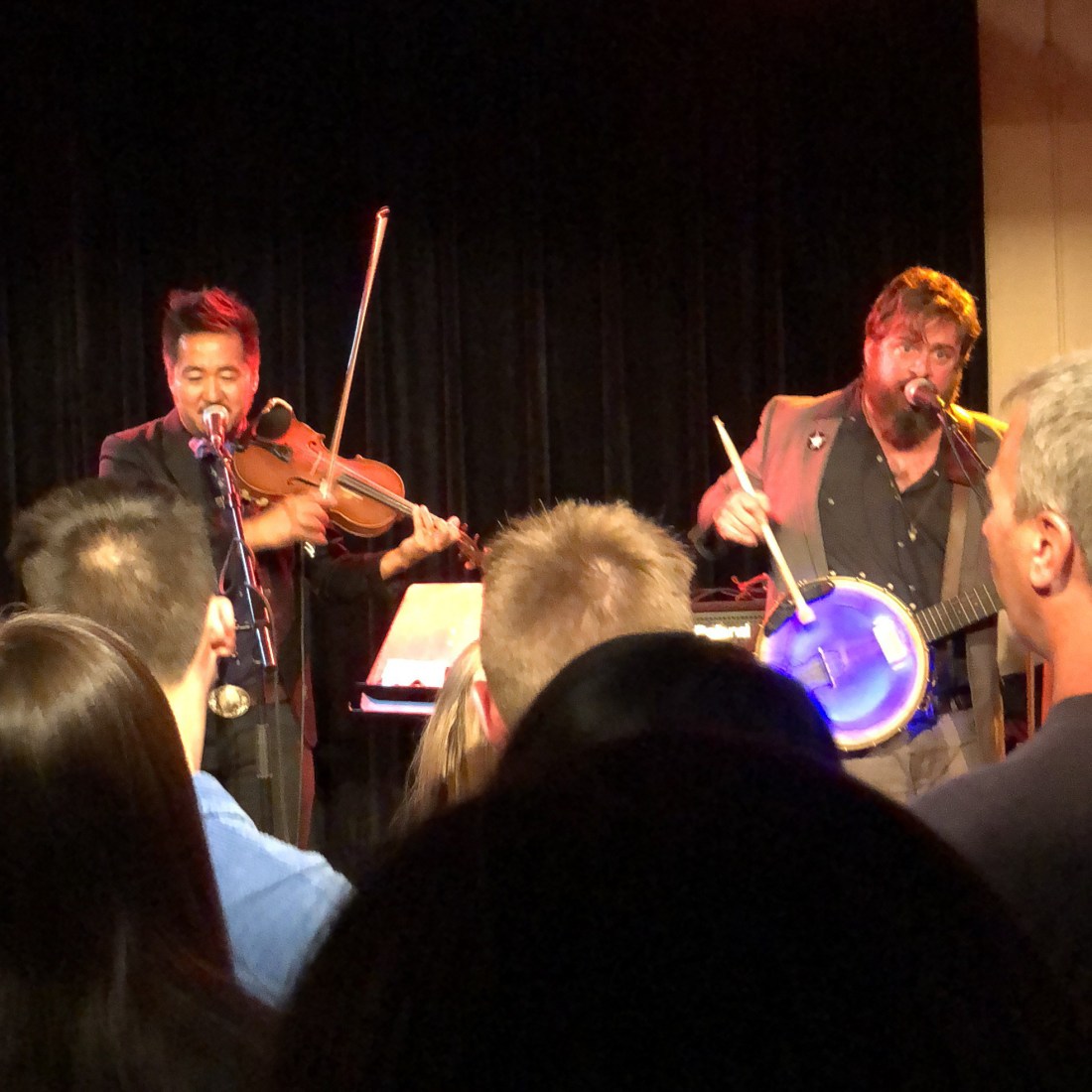
For the most part at Oberlin, Kishi Bashi’s work had not been heard. Despite this, he flooded the Cat in the Cream to maximum capacity this last Saturday. This was a rare feat, especially for unknown performers. However, his social proof and music spoke for itself – As a multi-instrumentalist, graduate of Berklee College of Music, and composer, Kishi Bashi did not have to prove himself as an exciting act. But, he did anyway.

Bashi worked with longtime friend and banjo player Tall Tall Trees to put on an exciting performance. Half of the stage was filled with pedalboards for the two musicians, which were put to good use. The show opened with Bashi as a solo act, playing songs from his 2016 release Sonderlust. I was able to talk to him while writing a show preview for the Oberlin Review, and he was absolutely right when he said his live style is completely different from his studio sound. What remained was his effortless control over the sound from his violin, and filling the room with lower octaves on the violin through the use of his effects board.

It was magic. The weight of the audience was lifted around me, and I was finally calm. Bashi touted his classical training in his traversals up and down the neck of the violin. Students clapped along whenever they could- One would think that for a campus of conservatory students the clapping would stay on beat. Other minor hiccups included the lack of an optimized sound on stage, where both performers turned a joke into the constant requests for turning microphones up and down.

One cannot write down Bashi’s performance as static- There were changes at every corner. He started to beatbox, which served as a driving force in his songs. He blended in pizzicatos as he built his songs, and harmonized with himself. His duo partner joined the fray, and proudly boasted his glowing banjo (He called it the banjotron), which he used as a drum. But this was not a traditional folk setting- Trees acted as a rhythmic and percussive section for Bashi. The use of the banjo was comparable to an electric guitar at times, and a drum in other songs. The momentum of the finished songs was incredible, but they ended as soon as they started. Bashi built up his next songs just as quickly, but he never put himself in the groove of each piece for too long.

Bashi and Tall Tall Trees had a wonderful dynamic together- They have known each other for years, and picked up wherever they left off. In an on-stage comment, Trees said that no matter how long time had passed between them, Bashi’s new material always kept its signature style. The improvisational portions of the show kept a break between looped songs. They captured the intimacy between the two as performers who know each other’s styles and repeated motifs- You could see it in the smiles and locked eyes between one another.Kishi Bashi Duo, 10/13 @ Cat in the Cream

Radio Writeup

I turned on the internet radio to WBWC for ten minutes today. It began with an advertisement for Nelly’s Cage Free Eggs- I knew I was in for a treat. Then, the Dj played a 2007 throwback of a song “Kamakazie.” I didn’t hear the artist name because he talked way too fast- This meant I didn’t hear the title of the next song.

And I absolutely did not care for the next song. I almost shut off the radio, in fact. It was shallow, compressed, and felt like a musical flurry of punches towards my attention, each of them missing. Is this what people listen to? (I sound like an old man)

There was a sigh of relief at the sound of a news announcement, something about the DOW Jones. Oh well, ten minutes were up.

What’s frightening is not how the content of the certain was in poor taste, but how quick I was to instinctively change it. I had no patience for it whatsoever while actively listening. Huh.


Blog Post #5

Any sort of musical mass media makes them an easy conduit for propaganda. While the radio as a medium allowed accessibility into the homes of citizens, Hitler propagandized jazz. Through careful restrictions, “lively propaganda swing arrangements” and “Nazi-approved numbers” flooded state-sanctioned radio stations. However, there’s not enough information on whether or not this was effective.

What’s difficult about propagandizing musical mass media is the subjectivity behind music itself, particularly lyrical content. (I’m starting to sound like the authors we’ve been reading lately) I’m sure that if you played an instrumental jazz piece for someone, they would not be able to identify it as “Nazi Jazz” unless they knew the specific composition rules behind it.

The argument that music is relative does not apply in this context. If a piece of music with lyrics is propagandized, the people in power control the message of the song, thus destroying any possibilities of its misinterpretation. This is what makes music effective.

Another way that musical mass media can serve as a platform for propaganda is to serve as a reflection for what the music represents. For example, classically-inspired compositions can represent the complexity behind a culture (In this sense, Nazis promoting the Aryan Race). However, it’s interesting to see how Nazi Germany targeted jazz as a platform for propaganda, considering its ethnic roots. Was this a populist appeal? The research in the quarterly academic review stated that the propaganda was only effective it sat well with listeners initially, in that they agreed with it.

However, compositions with lyrics can be effective, only if they have a strong hook; Especially if they are marketed as children’s songs. Think about it- a song like “Ring Around o Rosie” with propagandized lyrics would be effective. Of course, the research behind the effectiveness of radio and music propaganda is lacking.

I would argue that the medium that which propaganda is distributed is more important than the musical conduit for it. If nobody can see or hear the messages, then it does not work.

This week’s response is a little shorter than what I usually put out- I did not want to stretch an argument too far, and I feel as if I’ve made all the points concisely.

Post #4- How can music radio play a role in social change?


Music radio plays a role in social change in serving as a platform for communities. While the change may not always be widespread, it can serve as a backbone for communities. The WDIA emphasized community service, and was a hub not only for black music, but also for charitable causes. Its role in social change came from its popularity within the black community in Memphis in creating a platform for discussion. Shows such as Brown America Speaks allowed just about anyone with a radio in the area to have access to a community-oriented dialogue. One could argue that because the WDIA was segregated by other networks, it had little role in easing race relations at the time. But, because of its core audience of local black listeners, it was central in creating a space for dialogue among the black community as an “ideological, psychological, and organizational resource best.”  It was important for black listeners to be hearing a black DJ, instead of being shouted at by conservative white radio entertainers playing exclusively white music.

Berland’s interpretation of radio’s effect on social change is a stark contrast to Jenkins’ analysis of the WDIA. Berland defines “pervasive recentralization” as the shift in the location of authority to more abstract and distant centers, which in turns erodes the more proximate centers of authority. Rather, Berland focuses on the relationship in the national sphere, instead of the localized sphere in Jenkins’ piece. Because of this, Berland can conclude that the radio as a medium has little to no effect on social change because it is defined by the formatting of music, it is dominated by monopolies, and that it only has an effect on the local level because of its availability radius. The location of authority is constantly shifting, but the geographic confines of radio make it unique to its area and listeners. Radio could not have a role in social change on a national scale because of this, but this should not discredit the effect it has on its local listeners. In the local context, the location of authority is the radio station itself, but there are opportunities for more than just one local radio station to air its content. This is actually the advantage of radio stations, in their ability to broadcast certain types of music to the same audience.

Radio as a sonic medium is effective in social change at the local level by serving as a community platform for charity and social dialogue. However, on the national scale, radio has its limitations when compared to the monopolization of musical mediums, and its geographic confinements.

Mediation Writeup

The two articles we analyzed talked about mediation and music. I found mediation to come close with the term “medium,” in the way that music is heard. Based on the readings, I interpreted “mediation” to mean the way a medium interacts with the experience of listening to music, and how it can affect the viewer. Negus’ article repeated the same claim in different contexts when discussing the effects the medium of radio and music videos have on music. There was no strong conclusion, in that music is relative- this was frustrating.

Negus concludes: “Hence, significant struggles over musical meaning are not just occurring during production or among audiences but among those moments in between” (Negus 96).

Well…That’s a little obvious- The medium in which you enjoy music affects your experience. One could go into various debates about musical authenticity and how geographic exclusivity of music is forever doomed. Thanks, Negus.

Music and Musicking was a little different. To the author, the purpose of music lies within the musical experience itself, particularly in the act of listening. This means that music is independent from social, political, or religious beliefs. Okay, Small, but what about pieces that serve a purpose to explicitly serve a social, political, or religious purpose?

Excuse the sarcasm. Negus and Small just use a lot of musical jargon to say simple things, and they take way too long to get to their conclusions.

Post #3: Rock & Roll and Commodification

As Auslander explores, the commodification of recordsled to their consumption for reasons behind auditory means, in one could argue that people are buying records “for the wrong reasons.” They bring up anecdotal evidence of a deaf man collecting records because of the visual aesthetic of the covers, and a man named Clarence only buying records that bear his name. Auslander looks beyond the context of the medium of records and points to the relevance of music in the digital format, and disagrees with the work of Debord’s The Society of the Spectaclein that the highest point of a product to achieve capital accumulation is when it becomes an image. Sourcing Debord’s argument is clearly unfair because he never would have guessed that the digitalization of music through MP3’s would lead to hyper-commodification.

Auslander’s analysis of the physicality and visualization of music as a medium constitutes a dialogue with Grossberg’s analysis on the impact and function of rock and roll. It takes an entire research analysis through the lens of sociology and historical determinism for Grossberg to come to the conclusion that rock and roll is relative, and that to study its impact and function does not point to a definitive answer because of the context as a reactionary genre. Of course, the commodification of music impacted the consumption of rock and roll. Auslander and Grossberg would both agree that the rock and roll cannot exclusively rely on an ocularcentrist format because of the genre’s relativism.

That being said, the relativism of rock and roll through the availability of a tangible medium such as the record created subgroups and identities. The commodification and capitalist exploit of rock and roll became ironic because of its divisive “Us vs. Them” sentiments and acute self-awareness. What is most important is how the influence of rock and roll played on young audiences. Commodification did not have as much as much as an impact as Grossberg claims, because the context of the genre changed over time. However, it did have a general framework of self-awareness and a rejection of social norms, but the fragmentation of rock and roll’s audience was inevitable. This is because of what the genre represents on its own as reactionary force strictly relying on context. For example, the subdivisions of rock and roll audiences splintered between age groups over time as a result of its commodification, thus leading into three different categories of affirmation: critical, experiential, and utopian. Because of the “Us vs. Them” rhetoric behind rock and roll, the division of rock and roll fans through these categories effectively killed the genre because it became more relative over time.

The commodification of music did not prove to be a core part of the fragmentation of its audiences because of the core values the genre represented.

The Appeal of 45’s to Youth in the 1950s


The 45RPM was successful because of large budget behind RCA’s stubborn marketing strategy, which in turn led to its total overhaul of the traditional 75’. Because the medium changed, so did the audience. Curtis explores this in their discussion on sociotechnological interpretation of popular music. They claim that technological determinism is responsible for the changing tastes in popular music, meaning that technology is responsible for changing tastes and accessibility, and the general future of the music industry. This runs contrary to the argument that music itself and its accessibility, along with the tastes of listeners, determines what medium it is distributed through.

This makes sense- the medium that music is distributed through can completely change its geographic accessibility. One can make the argument that the commodification of music is purely based on reactionary forces to economic stagnation or boom, such as after the Great Depression or World War II. While economic patterns determine market values, the commodification of music was the availability of it before such events in the twentieth century. It is important to take a balanced perspective when considering technological determinism and reactionary economic patterns based on outside influences.

Accessibility comes next – The appeal of a 45RPM to a listener comes from its accessibility as a commodity. While the physicality of the medium itself is a commodity, including the material it is made on, it is the physicality of music that adds a sense of ownership to a piece of work. Of course, the commodification of music did create a more casual relationship with music, but the accessibility of an LP did give opportunities to youth in the 1950s to experience it as a common bond. Curtis gives another interesting point in this case. They claim the aural complexity of popular music became so difficult to concentrate on in background settings because of new editing processes, such as a pop song in the radio, that genres such as rock music became a private listening affair. In turn, a common bond among youth became listening to the record itself, almost in a private act of musical communion. An even stronger bond between artist and audience became apparent with the introduction of B-Sides, which often were more intimate or flawed takes of a song.

When examining the 1950s, the rise of the 45RPM can be attributed to the record’s contents. They only include enough for two songs, and were easily affordable. This relays back to the appeal of the 45RPM in comparison to previous mediums, such as the 33RPM or the 75RPM. They were widely distributed, which means that geographically confined music tastes were available to all. 45’s were color coded to genres which made them even more recognizable by music taste.

Based on the readings done in preparation for this response, I feel that they did not address the appeal of a 45RPM to younger audiences, but focused on the history of the physical medium of music and its relationship with shifting trends in audience.

Huyssen v. Frith, Post #1

Huyssen discussed the function and authenticity of pop based on cultural theory and its reproducibility, while Frith explored the shortcuts technology provides when creating music and how it can damage or create authenticity. Huyssen simply disagrees that pop was to be a democratization of art because of corporate uses, examined through defining art as a commodity with an economic and social value based on the work of Adorno, and Frith claims that the accessibility of technology was used by both listener and corporations to define authenticity. However, Huyssen poses the dilemma of pop art in Germany, where it was used for anti-authoritarian revolt. This aligns with Marcuse’s cultural theory of utopianism, where “the utopia to a better life express in bourgeois art need only be taken at its word” (Huyssen 81). This means the appeal of pop art in the Federal Republic was through its social critique, where its images were used to mockingly of the joys of everyday life.


Frith claims that the technology is used by both listener and corporations to define authenticity, while Huyssen states that the use of technology to reproduce art nullifies the function and authenticity of the art. This is found in the example of recording live concerts and copying music on empty cassette tapes, where the “record industry itself has treated home taping as the source of all its troubles” because they claimed they were used to acquire music illicitly (Frith 274).  Another example is the accessibility of cheaper equipment that produced genres like rock. However, Huyssen does concede that the indoctrination of Warhol’s work by capitalist interests serve its function of his work because of its social critique through cliché, bright colors used on normal photos and items. The mediums of technology are passively mentioned by Huyssen beyond reproducibility, which is a key distinction that is necessary when discussing the authenticity of art. This is important because the tools used to produce pop arguably shape the authenticity and intention of the piece. This is where these two authors differ, but Frith failed to differentiate between the use of reproduction technology and performance-enhancing technology. Huyssen altogether vilifies the use of technology in art because of the nature of capitalism, where only the powerful can dictate the function and authenticity of art. Because of its reproducibility, “Pop, however, art became profane, concrete and suitable for mass reception” (Huyssen 79). To Huyssen, function is more important than the technology used to create the art. It is difficult to compare the pieces to one another because Frith analyzes the impact of authenticity which technology has on pop, while Huyssen engages with the economic value of pop and its function of social critique is diminished through reproducibility.


WC: 450